
Many online sellers in Bangladesh are busy every day — messages, orders, parcels — and still find that the bKash balance is thin at the end of the month. The usual reason is not low sales. It is a price that looked profitable on paper but quietly lost money after courier charges, ads and returns. If you know how to calculate profit margin properly, you can see that leak before it costs you a month's work.
This guide walks you through it step by step with one product and real-looking taka numbers. No accounting degree needed — just a calculator, a notebook or a spreadsheet, and twenty minutes.
What profit margin actually means
Profit margin is the share of your selling price that you keep as profit. It is always a percentage of the price, not of the cost.
Profit margin (%) = Profit ÷ Selling price × 100
If you sell a kurti for ৳1,200 and keep ৳300 after all costs, your margin is 300 ÷ 1,200 × 100 = 25%. Out of every ৳100 a customer pays you, ৳25 is yours.
The tricky word is "profit". Depending on which costs you take away, you get three different margins, and each one answers a different question:
| Margin | What you subtract from the price | The question it answers |
|---|---|---|
| Gross margin | Only the product cost (buying or making it) | Is the product itself priced well? |
| Per-order margin (contribution) | Product cost + packaging, courier, COD charge, ads, returns | Does each delivered order really make money? |
| Net margin | All of the above + rent, salaries, internet, software, other monthly costs | Does the whole business make money? |
Most sellers only look at the first one. The money is lost in the second and third.
How to calculate profit margin step by step
We will follow one example product all the way down. The numbers are examples to show the method — use your own supplier price, your own courier's rate card and your own ad results.
The product: a cotton three-piece sold on a Facebook page and a website, cash on delivery.
- Selling price: ৳1,200
- Product cost (buying from the supplier, or fabric + making): ৳550
Step 1: Gross profit and gross margin
Gross profit = price − product cost = 1,200 − 550 = ৳650
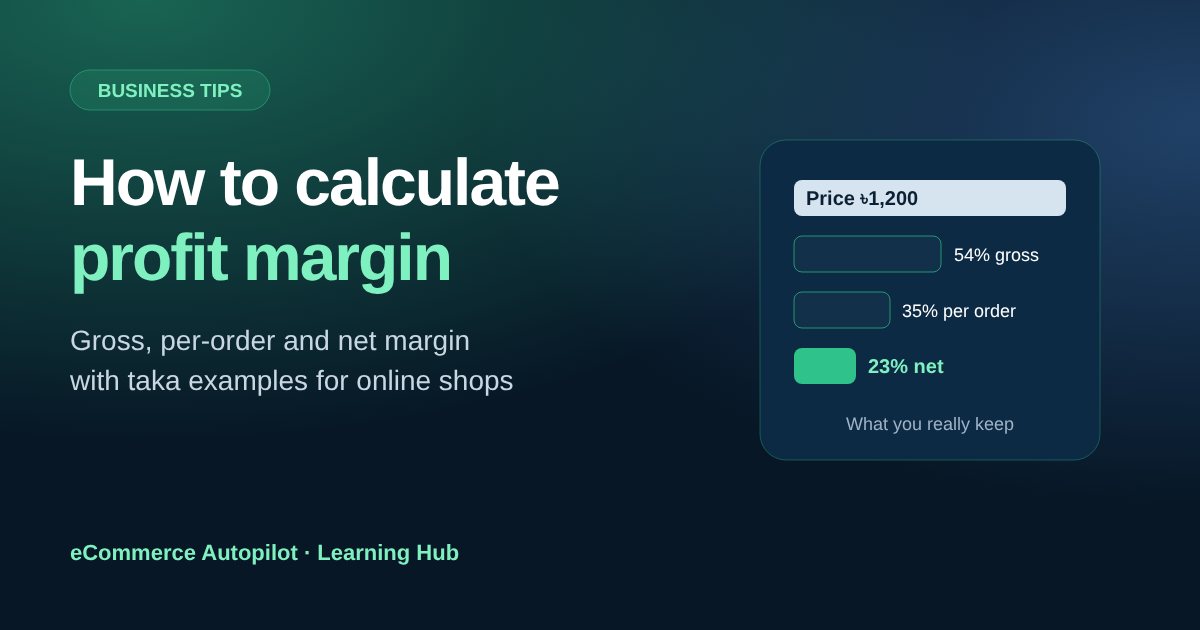
Gross margin = 650 ÷ 1,200 × 100 = 54.2%
This looks healthy. Hold that thought.
Step 2: Add the costs of getting one order to the customer
Every delivered order carries small costs that are easy to forget. In our example:
- Packaging (poly bag, tape, invoice print): ৳25
- Courier COD charge: say 1% of the amount collected = ৳12 (check the real percentage on your courier's rate card)
- Delivery charge you pay above what the customer paid you: ৳20 (for example, you charge the customer ৳100 outside Dhaka but your courier charges more for the weight)
These add up to ৳57. Profit left: 650 − 57 = ৳593.
Step 3: Add the advertising cost per order
If you run Facebook ads, every order has an ad cost behind it. Work it out like this:
Ad cost per delivered order = Ad spend in the month ÷ Delivered orders that came from ads
Say you spent ৳30,000 on ads last month and 200 delivered orders came from them. That is ৳150 per order.
Profit left: 593 − 150 = ৳443. Per-order margin before returns = 443 ÷ 1,200 = 36.9%.
Step 4: Spread the cost of returns over your delivered orders
This is the step most sellers skip, and it matters a lot with cash on delivery. A returned parcel earns nothing but still costs you money: the outward delivery charge, usually a return charge, and the packaging.
In our example, a return costs about ৳115 (৳60 delivery + ৳30 return charge + ৳25 packaging). Suppose 15 out of every 100 parcels come back.
For every 85 delivered parcels you pay for 15 returns. So the return cost carried by each delivered order is:
15 ÷ 85 × ৳115 = about ৳20
Profit left: 443 − 20 = ৳423. Per-order margin = 423 ÷ 1,200 = 35.3%.
If your return rate is high, this number grows fast — our older post on how to reduce courier returns has nine ways to bring it down.
Step 5: Add your fixed monthly costs
Rent, staff salaries, internet, phone bills, software and your own salary do not change with each order, but the orders have to pay for them. Divide them by your delivered orders:
Fixed cost per order = Fixed costs in the month ÷ Delivered orders in the month
Say your fixed costs are ৳60,000 a month and you deliver 400 orders: ৳150 per order.
Net profit per order = 423 − 150 = ৳273
Net margin = 273 ÷ 1,200 × 100 = 22.8%
So the product that "makes 54%" actually keeps about 23 taka out of every 100. That is still a good business — but it is a very different picture, and it changes how much discount you can give and how much you can spend on ads.
Markup vs margin: the mistake that underprices products
Many sellers say "I add 100% on top of my cost" and think they have a 100% margin. They don't. Adding 100% is a markup; it gives a 50% margin.
- Markup = profit ÷ cost
- Margin = profit ÷ price
In our example the gross profit is ৳650 on a ৳550 cost: a 118% markup, but a 54.2% margin. Both are correct; they just measure against different numbers. Use this table to switch between them:
| If you add this markup on cost | Your gross margin is |
|---|---|
| 25% | 20% |
| 50% | 33.3% |
| 100% | 50% |
| 150% | 60% |
| 200% | 66.7% |
Margin = Markup ÷ (1 + Markup) — for example 1.0 ÷ 2.0 = 50%.
When a supplier, partner or investor asks about your margin, they almost always mean profit as a share of the price.
How to set a price from the margin you want
Once you know the margin you need, you can work backwards to a price instead of guessing.
Price = Cost ÷ (1 − Target margin)
Example 1 — gross margin. Your product costs ৳550 and you want a 55% gross margin: 550 ÷ (1 − 0.55) = 550 ÷ 0.45 = ৳1,222. Round it to a price customers like, such as ৳1,250.
Example 2 — per-order costs included. Add every fixed taka cost per order: product ৳550 + packaging ৳25 + extra delivery ৳20 + ads ৳150 + returns ৳20 + fixed ৳150 = ৳915. The COD charge is a percentage of the price, so take it out of the margin instead: if you want 20% net profit and the COD charge is 1%, then 915 ÷ (1 − 0.20 − 0.01) = 915 ÷ 0.79 = ৳1,158. Your ৳1,200 price clears that target with a little room to spare.
Do the same for every product in your top ten. You will usually find one or two that look busy but earn almost nothing.
How a discount eats your margin
Discounts feel small to the customer and huge in your profit. Take our product with 10% off: the price drops from ৳1,200 to ৳1,080.
- Gross profit falls from ৳650 to ৳530 (−18%).
- Per-order profit before returns falls from ৳443 to about ৳324 (the COD charge also drops a little to ৳10.80) — a 27% fall.
To earn the same money as before, you would need about 443 ÷ 324 = 1.37 times as many orders — 37% more — just to stand still.
That does not mean "never discount". It means: know the number before you run the offer, and prefer offers that protect margin, like a free gift that costs you ৳40, a bundle ("buy 2, save ৳100"), or a coupon only for returning customers. If you sell on your own website, a coupon code lets you limit who gets the discount and for how long.
Quick profit margin checklist for each product
Run through this list for your ten best-selling products. Write the answers in a notebook or spreadsheet.
- Product cost — the real landed cost, including transport from the supplier and any making charges.
- Packaging — bag, box, tape, printed invoice, thank-you card.
- Courier — the delivery charge you pay minus what the customer pays you for delivery, plus the COD charge percentage.
- Ads — ad spend ÷ delivered orders (not ÷ messages or ÷ confirmed orders).
- Returns — return rate ÷ (1 − return rate) × cost of one return.
- Fixed costs — monthly fixed costs ÷ delivered orders.
- Net profit per order — price minus all of the above.
- Net margin — net profit ÷ price × 100.
- Decision — keep the price, raise it, cut a cost, or stop pushing the product with ads.
A simple rule many sellers use: if a product's per-order margin (step 4 above) is below what you can afford for fixed costs, do not scale its ads until the price or costs change.
Where the numbers come from — and how to keep them up to date
The hard part is not the formula. It is getting honest numbers every month: which parcels were delivered, what the courier actually charged, how many came back, and what you spent.
- Courier charges and returns come from your courier's payout statements and parcel list. Check them every week, not just at the end of the month.
- Ad cost per order should use delivered orders. An order that is cancelled or returned did not earn anything.
- Fixed costs should include your own salary. If the business can only make a profit when you work for free, the margin is not real.
eCommerce Autopilot keeps these numbers in one place for you: seller orders, courier parcels with their delivery and COD charges, the cashbook and a profit & loss view, so you can see your real margin without building a spreadsheet. You can start free and try it with your own shop.
If you already use eCommerce Autopilot, these Help Centre answers show where each number lives:
If you are just starting out, our guide on how to start an online business in Bangladesh covers the steps before pricing, and the free profit margin calculator does the arithmetic for one product in a few seconds.
Common questions about profit margin
What is a good profit margin for an online shop? There is no single right number — it depends on your product, your ad costs and your return rate. What matters is that the net margin is positive after everything, and big enough to survive a bad month. Compare your own products against each other and against last month.
Should I count delivery charges the customer pays as sales? Keep them separate. Money the customer pays for delivery mostly goes straight to the courier, so counting it as sales makes your margin look better than it is. Only the difference you pay yourself is a cost.
How often should I recalculate? Whenever a cost changes — a new supplier price, a courier rate change, an ad cost that jumps — and at least once a month for your best sellers.
The one thing to do today
Pick your best-selling product and work out its net margin with the five steps above, using last month's real numbers. If it comes out below what you expected, you have just found the most valuable fix in your business this month — before running another ad or another discount.