
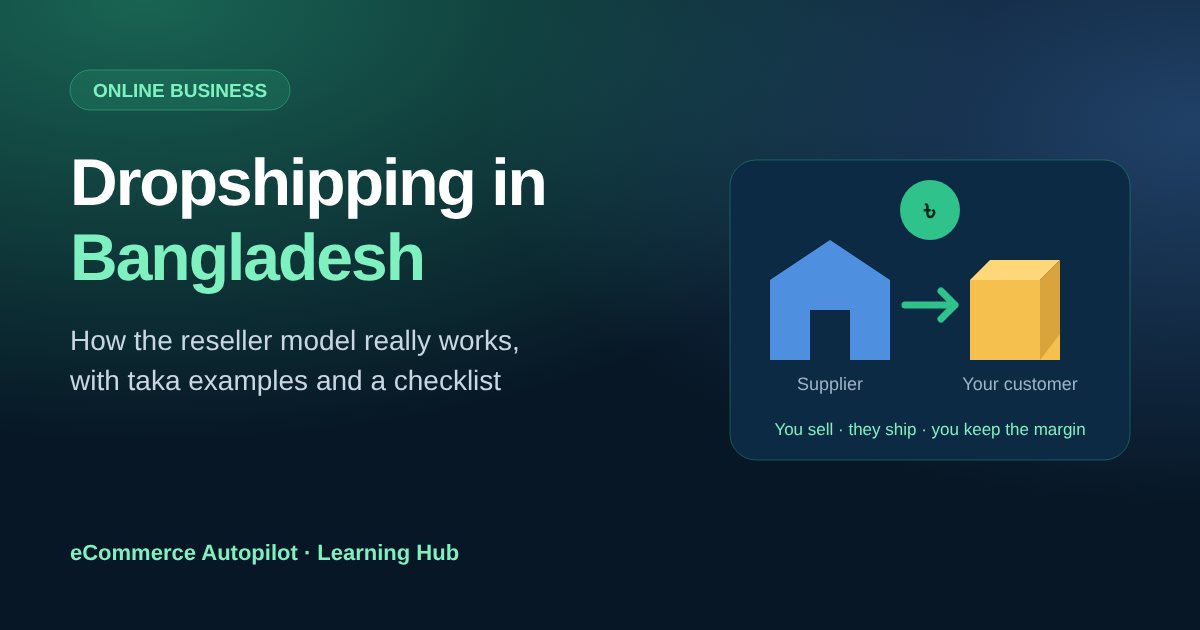
Selling online without buying stock first sounds like the perfect start: no warehouse, no money stuck in unsold products, no packing at midnight. That is the promise of dropshipping in Bangladesh — you take the order, a supplier packs and sends the parcel, and you keep the difference. It works, and many small sellers start exactly this way. But the version that works here is not the one in foreign YouTube videos, and the sellers who lose money usually lose it on things nobody told them about: returns, slow suppliers and margins that look fine until the courier charge is paid.
This guide explains how dropshipping really works in Bangladesh, how to choose a supplier, how to set a price that still makes money after returns, and a step-by-step plan to start in a week — with worked examples in taka.
What dropshipping means (and the two versions you will hear about)
In dropshipping, you sell a product you do not keep in stock. When a customer orders, you pass the order to a supplier, the supplier sends the product to the customer, and you earn the gap between your selling price and the supplier's price.
You will hear about two very different versions:
1. International dropshipping — a store sells products from an overseas marketplace, and the supplier ships from abroad straight to the customer. This is the model most global courses teach. For a Bangladeshi customer it usually means long waits, customs, payment in dollars and no cash on delivery. For a beginner selling to local customers it is rarely practical.
2. Local dropshipping (the reseller model) — a wholesaler, importer or small factory in Bangladesh keeps the stock, and resellers sell it on their Facebook pages, their own websites or marketplaces. The supplier packs the parcel (often with no supplier branding) and hands it to a courier, usually with cash on delivery. This is what most people mean by dropshipping in Bangladesh, and it is the model this guide focuses on.
| International dropshipping | Local reseller dropshipping | |
|---|---|---|
| Where the stock is | Overseas | In Bangladesh (often Dhaka) |
| Delivery time | Weeks | 1–5 days through local couriers |
| Cash on delivery | Usually not possible | Normal |
| Returns | Hard and expensive | Through the same courier, but someone pays the charge |
| Payment to supplier | International card / dollars | bKash, Nagad, bank — after delivery or in advance |
| Good for beginners? | Rarely | Yes, with the checks below |
How a local dropshipping order flows
Here is a typical order, start to finish. The details change from supplier to supplier, so agree every step in writing (even a WhatsApp message) before your first order.
The most important question hides in step 5: whose courier account is used? There are two common setups:
- The supplier books on their account. The courier pays the supplier. The supplier then sends you your margin (weekly, for example). Easy to start, but you depend on the supplier to pay you, and you cannot see the parcel status yourself unless they share it.
- You book on your own courier account and the supplier only packs and hands over (or the courier picks up from the supplier's address under your account). The cash comes to you and you pay the supplier their price. You control the money and the tracking, but you also carry the return charges directly.
Many sellers start with the first and move to the second once they have steady orders.
Step 1: Pick a product that suits dropshipping
Not every product is good for dropshipping. A good dropshipping product in Bangladesh usually:
- Has a clear price gap. If the supplier sells at ৳500 and similar products sell online at ৳600, there is no room for ads, delivery and returns.
- Is light and hard to break. Courier charges go up with weight, and broken parcels come back.
- Has few sizes and colours. Wrong-size returns are one of the most common reasons parcels come back. Gadgets, accessories, home and kitchen items, and beauty tools are easier than clothing with five sizes.
- Is easy to show in a short video. You will sell with photos and videos the supplier gives you, so ask for good ones before you choose.
- Is not only sold by 200 other pages. If the same photo appears on every page, buyers simply compare prices. Choose something you can explain better, bundle, or sell to a specific group of people.
Avoid medicines, copies of famous brands and anything that needs a licence. One complaint can close your page.
Step 2: Find and test a supplier
The supplier is your warehouse, your packing team and often your courier desk. Choose slowly.
Where sellers usually find suppliers: wholesale markets and importers they visit in person, small local factories (clothing, leather, crafts, food), reseller groups and supplier pages on Facebook, and people they already know in the trade.
Before you sell a single piece, order one product from the supplier as a customer, sent to your own address with cash on delivery. You will see exactly what your customer will see: how fast it ships, how it is packed, whether the product matches the photo, and whether anything inside shows the supplier's name or price.
Then agree these points in writing:
| Question | Why it matters |
|---|---|
| Reseller price for each product | Your margin is built on this number |
| Same-day or next-day handover? | Late parcels are cancelled at the door |
| Packing without their brand or price slip | The customer should see your shop, not theirs |
| Whose courier account, who pays the charge | Decides who carries the return cost |
| What happens to a returned parcel | Does it go back to stock, and who pays the return charge? |
| When and how you get paid (or pay) | Weekly by bKash? After each payout? |
| How they tell you about stock running out | Selling something they no longer have is the fastest way to lose a customer |
If a supplier will not answer these clearly, keep looking.
Step 3: Price with returns in mind (a worked example)
This is where most new dropshippers go wrong. They subtract the supplier price from the selling price and call the rest profit. It is not.
Let us take a made-up shop, "Rangdhanu Gadget", reselling a small kitchen tool. These are example numbers — your courier rates, ad costs and return rate will be different, so put your own in.
- Selling price: ৳850 (plus delivery charge, paid by the customer)
- Supplier's reseller price: ৳500
- Packing material charged by the supplier: ৳20
- Courier delivery charge: ৳120 (outside Dhaka in this example; the customer pays it on delivery)
- COD charge: we use 1% of the cash collected here (check your courier's own rate)
- Facebook ads: about ৳120 spent for every order you receive
When the parcel is delivered, you keep: ৳850 − ৳500 − ৳20 − about ৳10 COD charge = ৳320 before ads.
When the parcel comes back, the customer pays nothing, but the courier still charges the delivery charge (and sometimes a return charge). You lose about ৳120 + ৳20 packing = ৳140.
Now take 10 orders with 2 returns (a 20% return rate):
| Amount | |
|---|---|
| 8 delivered × ৳320 | +৳2,560 |
| 2 returned × ৳140 | −৳280 |
| Ads for 10 orders × ৳120 | −৳1,200 |
| Profit for 10 orders | ৳1,080 |
| Profit per order received | ৳108 |
The "margin" looked like ৳350 per piece. The real profit is about ৳108 per order received. If returns go up to 4 out of 10, the profit falls to ৳160 for 10 orders (6 × ৳320 − 4 × ৳140 − ৳1,200) — just ৳16 each — for the same work.
Two lessons follow:
- Returns and ads decide your profit, not the supplier price alone. A ৳30 better supplier price matters less than cutting returns from 30% to 15%.
- Price for the real numbers. If your sums only work with zero returns, the price is too low or the product is wrong.
For a full walk-through of margins, see our guide How to Calculate Profit Margin for Your Online Shop.
Step 4: Set up where you sell
You need a place where customers can see the product and order:
- A Facebook page is where most Bangladeshi resellers start. Good photos, a short video, clear price and delivery charge in every post, and quick replies to messages.
- Your own website makes you look like a real shop, lets customers order at any hour without waiting for a reply, and gives you a place to send ad traffic that you control.
You do not need to choose one forever. Many sellers take orders in Messenger and on a website at the same time — the work is keeping those orders in one list so none is missed.
eCommerce Autopilot gives you a free online store with your products, orders from the website in one list, supplier records and courier booking — you can start free and add your first product in a few minutes.
If you use it, these Help Centre guides help with the setup: add a product, add a supplier, and connect Steadfast courier if you book parcels on your own account.
Step 5: Run each order the same way
A simple routine stops most mistakes:
- Confirm every order by phone before sending it to the supplier. Check the name, full address, phone number, product, size and total.
- Check the customer's delivery history where you can. A number with many returns is a risk; ask for the delivery charge in advance by bKash or Nagad, or skip it. (eCommerce Autopilot has a customer fraud check for this.)
- Send the order to the supplier the same day, in one fixed format they cannot misread.
- Get the tracking or consignment number and save it with the order.
- Message the customer when the parcel leaves, with the expected day and the amount to pay.
- Follow up every parcel that is late, before the customer forgets they ordered.
- Match the money every week: delivered parcels, courier payouts, what you owe the supplier, and what the supplier owes you.
Most of the money lost in dropshipping disappears in step 7 — parcels nobody checked, payouts nobody matched. Write it down, even in a notebook.
Our guide How to Reduce Courier Returns goes deeper into steps 1, 2, 5 and 6.
The real risks (and how to protect yourself)
Dropshipping is low-cost to start, not risk-free. These are the problems sellers run into most often:
- The supplier runs out of stock after you have taken orders. Ask for a stock update every morning, and pause ads the moment a product runs low.
- The supplier sells the same product cheaper on their own page or to many resellers. Build something they cannot copy: better photos and videos, answers in your own voice, bundles and after-sale care.
- Late payment. If the supplier collects the cash, agree a fixed payment day and stop sending orders if it is missed twice.
- Quality changes. Order one piece yourself every few weeks to check the product has not changed.
- Returns you have to pay for. Know your return rate every week. If it climbs, find out why before spending more on ads.
- Your page gets the complaints. The customer does not know or care who the supplier is. Their bad experience is your bad review.
When to move from dropshipping to your own stock
Dropshipping is a great way to test products. Once one product sells steadily every week, keeping some stock yourself often makes sense: you buy at a better price for larger quantities, you pack faster and better, you control quality, and you can send same day. Many sellers keep a mix — best sellers in their own stock, new products tested through a supplier.
A simple sign: if you are paying the supplier for the same product every single day and you have one month's cash to spare, ask for their price on 50 or 100 pieces and do the sum again.
Dropshipping in Bangladesh: start-up checklist
- Choose one product with a clear price gap, light weight and few sizes
- Order it yourself from the supplier as a test, with cash on delivery
- Agree prices, handover time, packing, courier account, returns and payment in writing
- Work out your profit per order with your real courier charge, ad cost and a return rate of at least 20%
- Set up a Facebook page and, if you can, your own website with clear prices and delivery charges
- Confirm every order by phone and check risky numbers before sending
- Keep one list of orders, tracking numbers and payments
- Match courier payouts and supplier payments every week
- Re-check product quality with a test order every few weeks
Conclusion
Dropshipping in Bangladesh works best as the reseller model: a local supplier, local couriers and cash on delivery, with you doing the selling and the customer care. The money is made — or lost — in the details: a supplier who ships the same day, a price that survives returns and ads, and a weekly habit of matching parcels and payments.
Your one thing to do today: pick one product, order it from a supplier as a customer, and while you wait, do the 10-order sum above with your own numbers. If the profit still looks good with two returns out of ten, you have something worth selling.